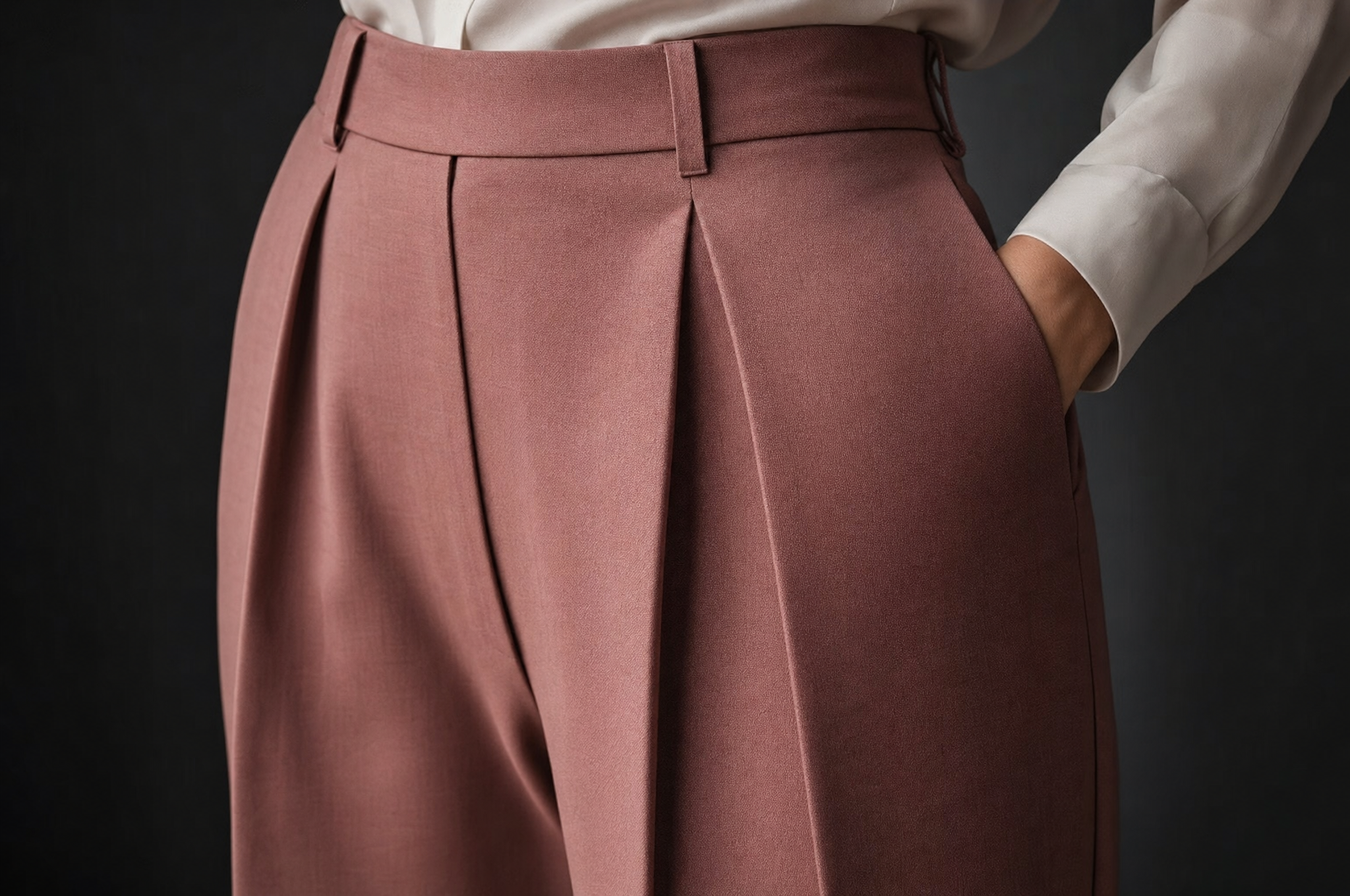
The pleated trouser has an image problem. For a generation of women, the word "pleated" conjures images of middle managers in beige chinos, of ill-fitting suit trousers from department store sales, of a garment that prioritizes utility over beauty. Pleats became associated with the corporate — with the boardroom, with the boring, with the clothes you wear because you have to, not because you want to.
This is a profound injustice to one of the most elegant construction techniques in tailoring. A well-made pleated trouser, styled with intention, is one of the most sophisticated garments a woman can wear. The problem isn't the pleat — it's the styling. Let's fix that.
Understanding the Pleat
Before we style them, let's understand what we're working with. A pleat is a fold of fabric that's been pressed and stitched into place at the waistband, creating extra fullness through the hip and thigh. There are two main types:
Forward pleats open toward the fly. They're the more traditional option, creating a clean, classic line. They're what you'll find on most tailored trousers and what most people picture when they hear "pleated."
Reverse pleats open toward the side seams. They create a slightly different silhouette — the fullness is distributed outward rather than inward, which can be more flattering on some body types. Reverse pleats tend to lie flatter and create a smoother front.
Both types serve the same purpose: they add room through the hip and thigh while maintaining a clean waistline. When you sit, the pleats open to accommodate the movement. When you stand, they fold back into place. It's engineering, not decoration — and when done well, it's beautiful engineering.
A pleat is not a design choice. It's a functional element that happens to be beautiful. Understand its purpose, and you'll understand how to wear it.
The Problem: Why Pleated Trousers Look Corporate
The reason pleated trousers read as "corporate" isn't the pleat itself — it's everything that usually accompanies it. The corporate look is a combination of elements: a stiff fabric, a high-rise in a conservative color, paired with a button-down shirt and a blazer. Each of those choices is fine in isolation. Together, they create a uniform that says "I am going to a job I don't particularly enjoy."
To make pleated trousers look modern, we need to break that combination apart. Keep the pleats; change the context.
Strategy 1: Soften the Fabric
The single most effective way to de-corporatize a pleated trouser is to change the fabric. Traditional corporate pleated trousers are made from stiff wool or polyester blends that hold their shape rigidly — they look like they're made of cardboard.
Instead, choose fabrics with movement and texture. Wool crepe is ideal — it has the structure to hold pleats but enough drape to feel fluid and modern. Tencel or lyocell blends offer a soft hand and beautiful drape. Lightweight wool in a tropical weave breathes and moves. Even a substantial silk can work for evening pleated trousers. The key is that the fabric should move when you move, not stand stiff like armor.
Our wool trouser guide covers the specific weaves that balance structure with drape — look for wool crepe and tropical wool if you want pleats that feel modern.
Strategy 2: Break the Top Half
If the corporate look is pleated trousers plus button-down shirt plus blazer, the solution is to replace two of those three elements. Keep the trousers; change what's on top.
Try these combinations:
- Pleated trousers + a fine-gauge knit: A soft merino or cashmere sweater replaces the button-down. The texture contrast — smooth wool against soft knit — is what makes it feel intentional rather than office-ready. Tuck it in to define the waist.
- Pleated trousers + a silk camisole: For evening, nothing de-corporatizes a pleated trouser faster than a fluid silk top. The pleats echo the softness of the silk, creating a cohesive, elegant look.
- Pleated trousers + a cropped sweater: A cropped knit that hits at the waistband changes the proportion entirely. Instead of the long-line corporate silhouette, you get something modern and fresh.
- Pleated trousers + a structured tee: A high-quality cotton tee, tucked in, with the sleeves pushed up. Casual, confident, and nothing like the office.
Strategy 3: Play with Color
The corporate look defaults to navy, black, and gray. There's nothing wrong with those colors, but if you want pleated trousers to feel modern, experiment with color.
A pleated trouser in dusty rose, sage green, or deep ochre immediately reads as fashion rather than workwear. Even a rich brown or burgundy changes the character of the garment. If you're nervous about color, start with a deep, muted tone — it's still versatile but distinctly non-corporate.
The pleat itself is enhanced by color. The way light catches the folds of fabric creates subtle variations in tone that add depth and richness. This is one of the great advantages of pleats over flat-front trousers — they interact with color in a way that flat fabric can't.
Strategy 4: Change the Silhouette
Pleats don't only come on tapered corporate trousers. They work on a range of silhouettes, and the silhouette changes everything about how they read.
A pleated wide-leg trouser is one of the most elegant garments in modern fashion. The pleats add fullness at the hip, and the wide leg carries that fullness all the way to the hem. The result is a trouser that moves beautifully and looks nothing like office wear. This is the silhouette to choose if you want pleats that feel editorial rather than corporate. Read our wide-leg guide for styling principles.
A pleated cropped trouser is another modern option. The pleats add visual interest at the waist, and the cropped length keeps the look light and contemporary. Pair with ankle boots or flats.
Even a pleated straight-leg can feel modern if the rise is right and the fabric is soft. The key is to avoid the narrow, tapered-to-ankle silhouette that's become the corporate default.
Strategy 5: Accessorize with Intention
Accessories are where the corporate look dies and the personal look begins. The same pleated trousers can read as office wear or editorial depending on what you pair them with.
To modernize:
- Shoes: Skip the sensible pumps. Try a pointed-toe flat, a sleek loafer, an ankle boot, or a strappy heel. The shoe should feel chosen, not defaulted.
- Belt: A leather belt in an unexpected color (sage, oxblood, cream) immediately personalizes the look. Or skip the belt entirely — many pleated trousers look better without one.
- Jewelry: Layered necklaces or statement earrings add personality. The corporate look avoids jewelry; the modern look embraces it.
- Bag: A structured top-handle bag reads corporate. A soft shoulder bag or a crossbody feels personal and modern.
The Pleated Trouser in Your Wardrobe
Once you've de-corporatized the pleated trouser, it becomes one of the most versatile garments in your wardrobe. A well-styled pleated trouser works for the office (yes, still), for dinner, for weekends, and for events. It's the kind of garment that does heavy lifting — the piece you reach for when you want to look put-together without looking like you tried too hard.
If you're building a trouser wardrobe, a pleated pair in wool crepe should be on your list. It's the bridge between the structured and the fluid, between the formal and the relaxed. It's the garment that proves pleats aren't a relic — they're a technique. And when you style them with intention, they're one of the most elegant things you can wear.
And don't forget: caring for pleated trousers requires special attention. The pleats need to be maintained through proper pressing and storage. Our guide to caring for tailored trousers covers everything you need to know.