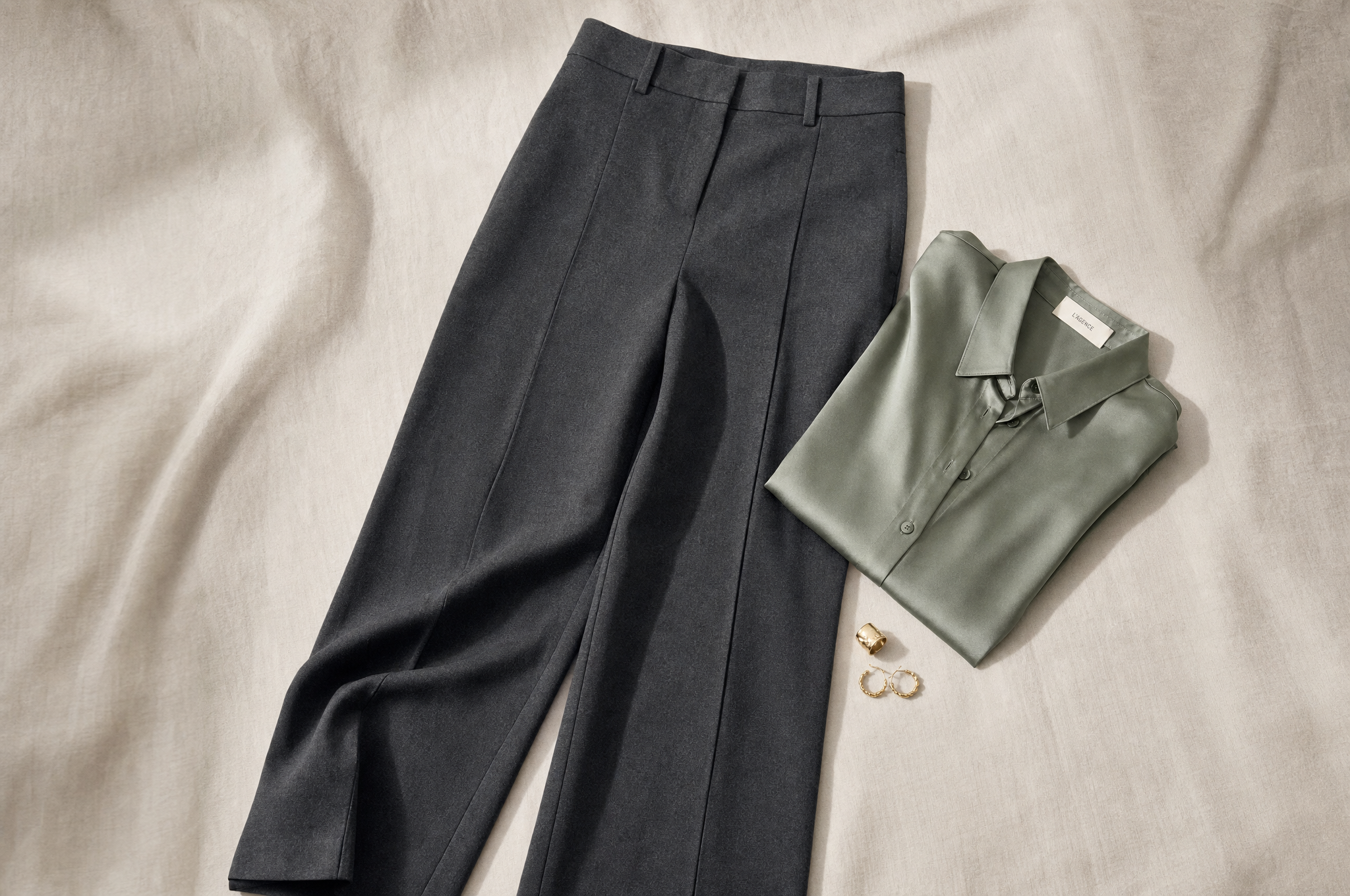
There is a particular kind of confidence that comes from wearing a well-cut wide-leg trouser. It's not loud. It's not aggressive. It's the quiet confidence of someone who understands proportion — who has figured out that drama and elegance are not opposites but collaborators. The wide-leg trouser, when it works, is one of the most elegant garments a woman can wear. When it doesn't, it makes her look like she's borrowed someone else's clothes.
The difference between those two outcomes is not about body type. It's about understanding what the wide-leg silhouette actually does, and styling it with intention rather than hope. Let's break it down.
What Makes a Trouser "Wide-Leg"
First, let's define our terms. A wide-leg trouser is cut with full volume from the hip (or high thigh) all the way to the hem. Unlike tapered trousers, which narrow toward the ankle, or palazzo pants, which are cut from a lightweight, flowing fabric, the wide-leg trouser is typically structured — it holds its shape rather than drifting in the breeze. Think wool, cotton twill, or a substantial linen blend rather than chiffon or silk.
The key measurement to understand is the leg opening. On a standard straight-leg trouser, the leg opening (the circumference at the hem) is roughly 15 to 17 inches. On a wide-leg trouser, that opening typically ranges from 19 to 24 inches. That extra fabric is what creates the drama — and what creates the styling challenge.
Who It Flatters (and Why)
Here's the truth that most fit guides won't tell you: the wide-leg trouser flatters almost every body type when it's cut correctly and styled with attention to proportion. The idea that it only works on tall, slim women is a myth born from lazy styling, not from the garment itself.
If You're Petite (Under 5'4")
The wide-leg can absolutely work for you, but you need to be strategic about three things. First, rise — a high rise elongates your legs, which is essential when you're working with a lot of fabric. Read our guide to understanding rise for the full breakdown. Second, length — the hem should graze the top of your foot or kiss the floor. Too short and the proportion looks off; too long and you'll trip. Third, shoes matter more than ever — a stacked heel or platform gives you height without looking like you're trying too hard.
If You're Tall (5'8" and Above)
The wide-leg was practically designed for you. Full-volume trousers look intentional on a tall frame because there's enough vertical space for the fabric to do its thing. Your main challenge is finding trousers long enough — which is why understanding your inseam measurement is critical. Many tall women are wearing trousers that are too short, which defeats the entire purpose of the silhouette.
If You're Curvy
The wide-leg is one of your best friends. Here's why: full volume from the hip creates a smooth, continuous line that skims rather than clings. The key is to avoid trousers that are too tight through the hip and thigh before flaring out — that creates a jodhpur effect that's rarely flattering. Look for a pair that's cut generously from the hip, sits at your natural waist, and falls straight down from the fullest part of your hip.
If You're Slim or Straight-Framed
The wide-leg adds visual volume, which can create the illusion of curves where there aren't many. Pair it with a fitted top to create contrast — the volume on the bottom, the structure on top, and the waistline defining where they meet. This is the proportion play that makes the wide-leg feel intentional rather than sloppy.
How to Style It: Five Principles
1. Proportion Is Everything
The single most important principle of styling wide-leg trousers is this: balance the volume. If your trousers are full and flowing, your top should provide contrast. This doesn't mean it has to be skin-tight — a tucked-in blouse, a cropped sweater, or a fitted knit all work. What doesn't work is a loose, untucked top over wide-leg trousers. You lose your waistline, you lose your shape, and you look like you're wearing a tent.
The wide-leg trouser doesn't hide your body. It reinterprets it. The goal isn't to disappear into the fabric — it's to let the fabric move around you.
2. The Waistline Defines the Look
Where your trouser sits on your waist determines the entire character of the outfit. A high-rise wide-leg trouser with a tucked-in shirt is polished and editorial. A mid-rise pair with a relaxed tee is effortless and weekend-ready. The same trouser, styled two ways, feels like two completely different garments. If you're new to the wide-leg, start with a high-rise — it's the most forgiving and the most flattering.
3. Footwear Makes or Breaks It
The relationship between your trousers and your shoes is critical with wide-leg. The hem should break gently over your shoe — not swallow it. A pointed-toe flat, a low heel, or a sleek boot all work. What doesn't work: chunky sneakers (they fight the elegance of the line) or shoes that are too dainty (they disappear under the fabric). The shoe should be visible but not dominant.
4. Fabric Dictates the Occasion
A wide-leg wool trouser is office-appropriate and evening-ready. A wide-leg linen trouser is a summer staple. A wide-leg silk or crepe trouser is formal. The silhouette stays the same, but the fabric changes everything about how and where you wear it. Our wool trouser guide breaks down the specific weaves that work best for structured wide-leg styles.
5. Confidence Is Non-Negotiable
This sounds like a platitude, but it's practical advice. The wide-leg trouser is a statement garment. If you wear it apologetically — tugging at the fabric, second-guessing the volume, hunching to minimize your presence — it shows. Stand up straight, let the fabric move, and own the silhouette. The wide-leg rewards presence.
Common Mistakes to Avoid
- Buying the wrong length. Wide-leg trousers that are too short look truncated and awkward. Invest in getting them hemmed properly. See our guide to finding your inseam.
- Wearing them too tight. The wide-leg is supposed to have room. If you size down to make them more fitted, you lose the entire point of the silhouette.
- Pairing with the wrong top. A long, loose tunic over wide-leg trousers creates a shapeless column. Tuck, crop, or define your waist.
- Ignoring the fabric. A wide-leg in a cheap, thin fabric will cling in all the wrong places. Invest in fabric with enough weight to hold its shape. Learn the difference in our fabric guide.
The Wide-Leg in Your Wardrobe
If you're building a trouser wardrobe from scratch, the wide-leg should be one of your first three pairs. It's the silhouette that does the most work — equally at home in an office, at dinner, or on a weekend. Pair it with a tapered trouser for everyday and a cropped pair for versatility, and you've covered most of your bases.
The wide-leg trouser is not a trend. It's a classic that happens to be having a moment. Learn to wear it well, and it will serve you for years — through every season, every occasion, and every iteration of fashion's pendulum. That's the beauty of getting the fundamentals right: they don't go out of style.