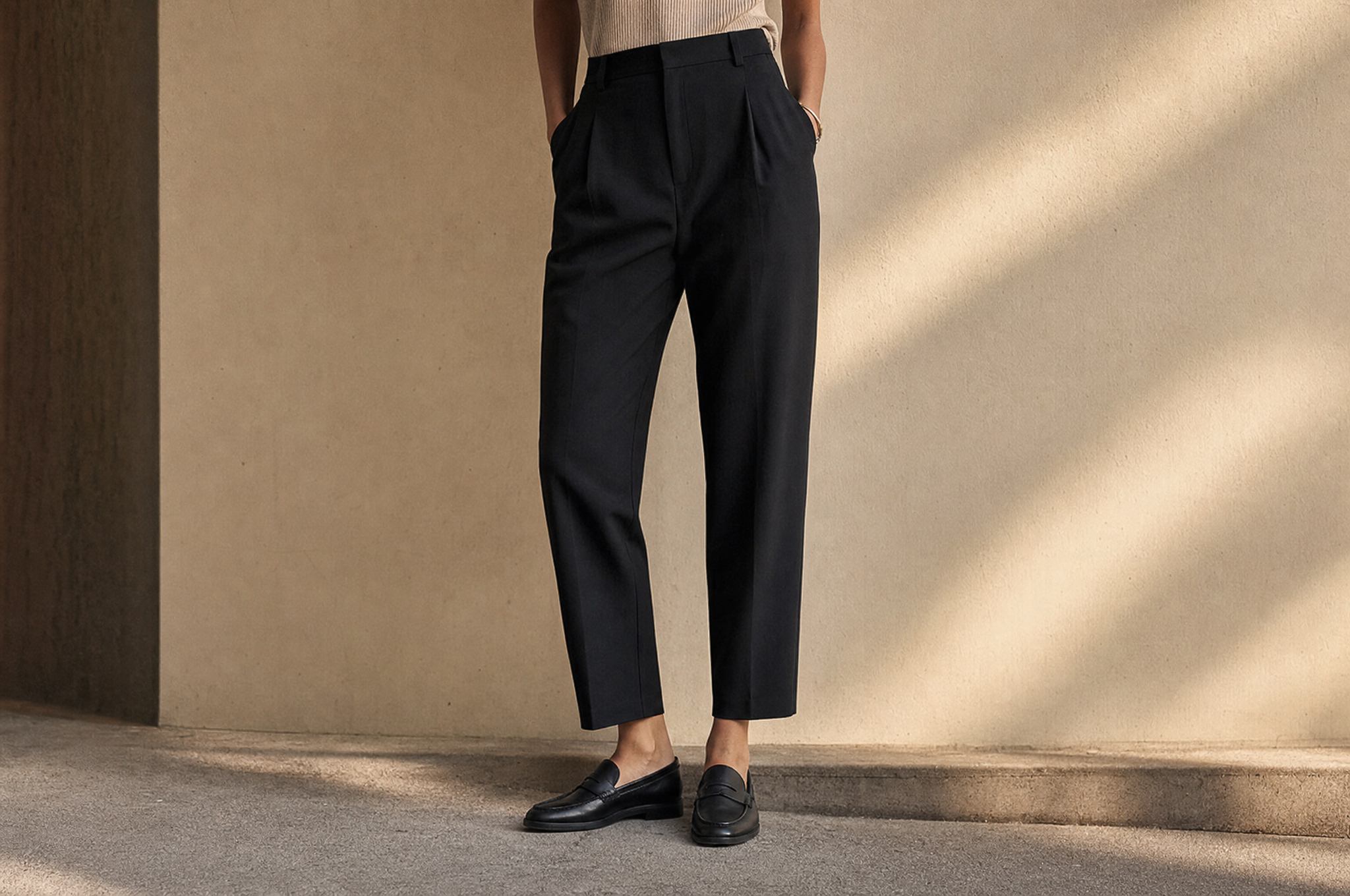
A woman once wrote to me about a pair of trousers she'd bought on sale. She loved everything about them — the fabric, the color, the drape. But she couldn't figure out why they looked wrong on her body. They made her feel short. They created an odd proportion she couldn't name. She was about to return them when she mentioned, almost in passing, that the waistband hit about three inches below her navel.
The problem wasn't the fabric, the color, or the drape. The problem was the rise. She'd bought a mid-rise trouser when her body — and her proportions — needed a high-rise. Once she understood that, everything else clicked into place.
Rise is the most overlooked variable in trouser fit. It's also the most important. Get it right, and everything else falls into place. Get it wrong, and no amount of tailoring will save the garment. Let me explain why.
What Is Rise, Exactly?
Rise is the distance from the crotch seam to the top of the waistband. It's the measurement that determines where the trouser sits on your body — at your hips, below your navel, or at your natural waist. It sounds simple, but its impact on your overall silhouette is profound.
Here's why: rise controls proportion. It determines where the visual break between your torso and your legs occurs. That break, in turn, affects how long your legs look, how long your torso looks, and where the eye is drawn when someone sees you. Change the rise, and you change the entire geometry of your body as seen by others.
The Three Rises, Defined
Low-Rise (Sits 2-3 inches below the navel)
Low-rise trousers sit well below the natural waist, resting on the hips. They were ubiquitous in the early 2000s and have recently experienced a quiet resurgence. Low-rise creates a long torso line and a shorter leg line. This can work beautifully if you have a naturally long torso and want to balance it, or if you have a shorter torso and want to create the illusion of length up top.
However, low-rise trousers come with genuine challenges. They're unforgiving around the midsection. They can create a visible gap at the back waist if your hips and waist are dramatically different sizes. And they shorten the leg line — which is why they're particularly tricky for petite women. If you're going to wear low-rise, pair them with a longer top that covers the waistband, and choose shoes that elongate the foot.
Mid-Rise (Sits 1-2 inches below the navel)
Mid-rise is the compromise — and for many women, it's the sweet spot. Sitting just below the navel, mid-rise trousers offer enough coverage to feel secure without the formality of a high waist. They neither dramatically elongate nor shorten the leg, making them the most neutral option.
Mid-rise works for most body types and most occasions. It's the rise you reach for when you want versatility — a trouser that works with a tucked-in blouse and with a casual untucked sweater. The main thing to watch for is the gap at the back waist, which is more common with mid-rise than with any other style. If you find a mid-rise that fits your hips but gaps at the waist, a good tailor can fix it for about twenty dollars.
High-Rise (Sits at or above the navel)
High-rise trousers sit at the natural waist — the narrowest part of your torso, typically at or just above the navel. They've dominated fashion for the past decade, and for good reason. High-rise is the most universally flattering rise because it does two things simultaneously: it elongates the legs and it defines the waist.
By pulling the waistband up to the narrowest part of your torso, high-rise trousers create a natural cinch. The eye is drawn to the waist, the leg line extends from the high waistband to the hem, and the overall effect is one of length and proportion. This is why high-rise is the go-to for wide-leg trousers — the combination of high rise and full volume creates the most leg-lengthening, waist-defining silhouette available.
High-rise doesn't mean high-maintenance. It means the trouser is doing the proportion work for you.
How Rise Interacts With Body Type
Rise doesn't operate in isolation — it works in concert with your body's natural proportions. Here's how to think about it:
If you have a short torso: High-rise is your best friend. It raises the visual waistline, making your torso appear longer and more balanced against your legs. Low-rise will do the opposite — it'll make your torso look even shorter by pulling the waistline down toward your hips.
If you have a long torso: You have the most flexibility. Mid-rise is often ideal — it creates a natural break that balances your proportions. Low-rise can also work, as it visually shortens the torso. High-rise can work too, but be aware that it'll make your legs look extremely long, which may or may not be the effect you want.
If you carry weight in your midsection: Mid-rise is often the most comfortable and flattering. It sits below the natural waist without cutting into the fullest part of the belly, and it avoids the potential muffin-top effect of low-rise. High-rise can also work if the trouser is cut generously — the key is to avoid anything that compresses or digs.
If you have a defined waist: High-rise will showcase it. The waistband cinches at the narrowest point, and the fabric falls from there. This is the classic hourglass-enhancing rise.
Rise and Silhouette: A Working Relationship
Rise also interacts with the trouser's silhouette. Here's a quick guide:
- High-rise + wide-leg: The most leg-lengthening, waist-defining combination. Editorial, polished, dramatic.
- High-rise + tapered: Sharp and modern. Works well for office and evening.
- Mid-rise + straight: Classic and effortless. The most versatile everyday combination.
- Low-rise + bootcut: A retro feel. Works if the proportions suit your body.
For more on how different silhouettes interact with rise, explore our fit guide hub and our comparison of tapered vs straight cuts.
Finding Your Rise
So how do you figure out which rise works for you? There are two approaches.
The measurement approach: Stand in front of a mirror in your underwear. Find your natural waist — the narrowest part of your torso, usually about an inch above your navel. Measure from there down to your crotch seam. That's your ideal rise measurement. Compare it to the rise measurements listed on retailer websites (the good ones list them).
The trial approach: Try on the same trouser in three rises. Many brands now offer the same cut in low, mid, and high. Try them on in a fitting room with a full-length mirror, take photos, and look at them on your phone later. You'll be surprised how clear the difference is when you see it in a photo rather than in the moment.
And remember — rise isn't just about flattery. It's about comfort. A trouser that fits beautifully but makes you uncomfortable is a trouser you won't wear. The best rise for you is the one that makes you feel like yourself.
The Bottom Line
Rise is the foundation of trouser fit. It controls proportion, comfort, and the overall character of the garment. Understanding it — and knowing which rise works for your body — is the single most important step you can take toward building a wardrobe of trousers that actually fit.
Once you've mastered rise, the next step is understanding inseam — the other critical measurement that most women get wrong. Together, rise and inseam are the two numbers that determine whether a trouser works or doesn't. Get them right, and you're most of the way there.