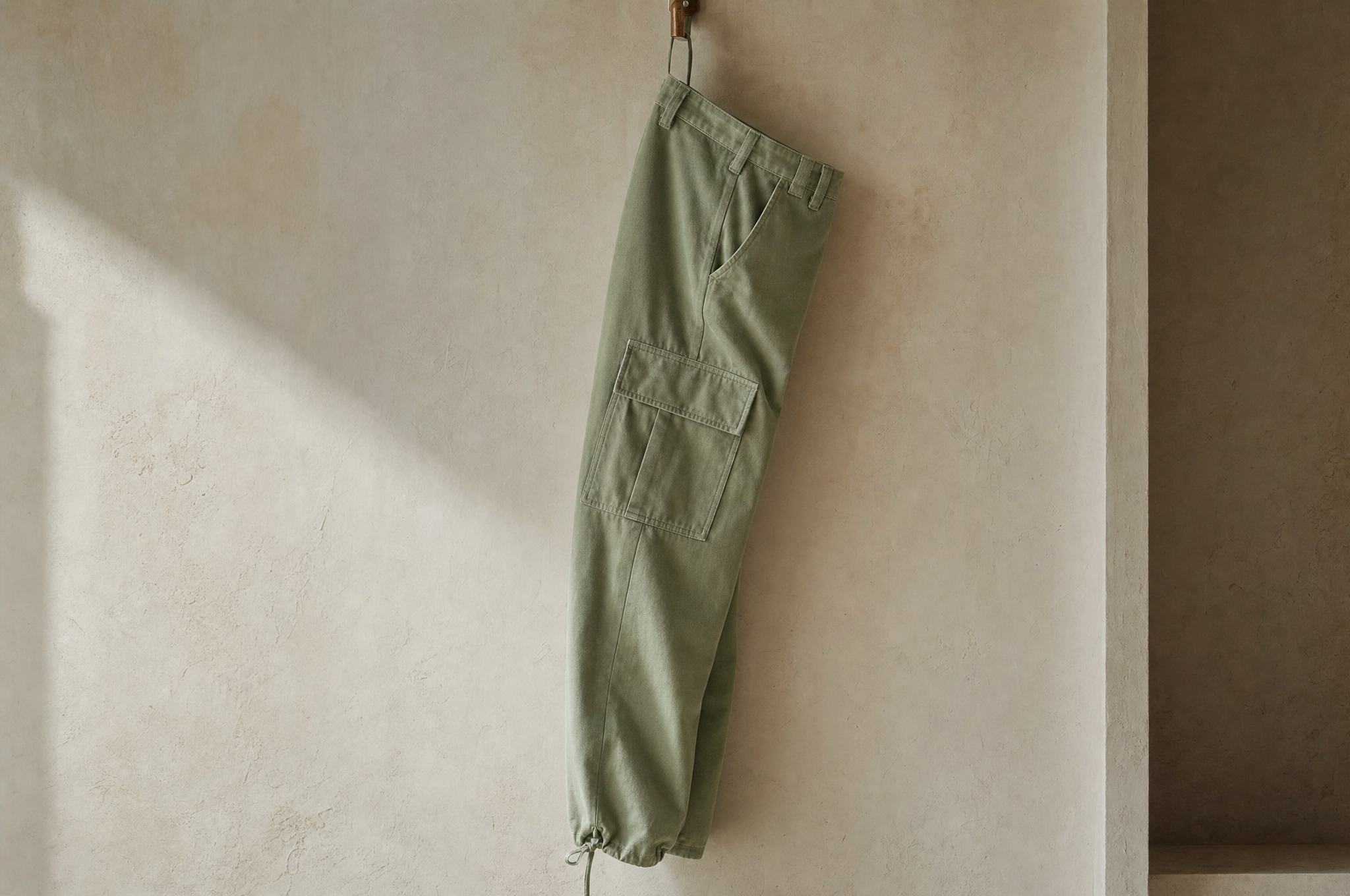
Let's address the elephant in the room. When I say "cargo pant," your mind goes somewhere specific. It goes to 2003 — to low-rise khaki cargo pants with enormous bellows pockets, worn with a baby tee and platform flip-flops. It goes to a garment that was equal parts fashion statement and practical joke, a style so deeply of its era that the very word "cargo" became a shorthand for everything wrong with early-2000s dressing.
Forget all of that. The cargo pant has returned, and it has returned transformed. The 2026 cargo is a different garment entirely — slimmer, softer, more refined, and infinitely more wearable. It's one of the most interesting developments in contemporary trouser design, and it deserves to be understood on its own terms rather than dismissed because of its ancestor's sins.
Here's what's happening, why it's happening, and how to wear it.
The Evolution: What Changed
To understand why the cargo pant works in 2026 when it didn't in 2003, you have to understand what's different. And almost everything is different.
The Silhouette
The original cargo was baggy. It was cut wide through the leg, often with a tapered ankle, creating a shape that was both voluminous and undefined. The 2026 cargo is slim and tailored. It's cut closer to the body — not skinny, but fitted enough to show the shape of the leg. The volume that characterized the original is gone, replaced by a cleaner, more intentional line.
The most common modern cut is a relaxed tapered silhouette — roomy through the thigh, narrowing from the knee to the ankle. Think of it as a tapered trouser with cargo pockets, rather than a shapeless bag with pockets sewn on. The fit is deliberate, not accidental.
The Pockets
The original cargo's pockets were enormous — bellows pockets that bulged outward, adding bulk to the hip and changing the silhouette of the entire garment. The 2026 version features smaller, flatter, more integrated pockets. Some are flat panels with a flap; others are side-seam pockets that sit flush against the leg. The pocket is present as a design element, not as a storage solution. You're not actually supposed to put things in them.
The cargo pocket in 2026 isn't functional. It's decorative. And that's not a criticism — it's the difference between utility wear and fashion inspired by utility wear.
The Fabric
The original cargo was made from stiff, heavy cotton twill that stood away from the body and wrinkled aggressively. The 2026 cargo comes in a range of fabrics: softer cotton twills with a bit of stretch, fluid wool blends that elevate the garment entirely, even silk and satin versions that transform it into evening wear. The fabric is what makes the modern cargo feel modern — it drapes rather than stands, it moves rather than holds.
The Rise
The original cargo sat low — often very low, at the hip, creating that distinctive early-2000s proportion. The 2026 cargo typically sits at a mid-to-high rise, which changes the entire character of the garment. A higher rise makes the cargo feel intentional and polished rather than slouchy and adolescent.
Why It Works Now
There's a reason the cargo has returned, and it's not just fashion's cyclical nature. The cargo pant fills a gap in the modern wardrobe that no other trouser currently fills: the space between tailored and casual.
Think about your options. On the formal end, you have wool trousers and tailored pants. On the casual end, you have jeans and joggers. But what about the middle? What do you wear when jeans feel too casual and wool trousers feel too formal? For years, the answer was chinos — but chinos have their own baggage (preppy, corporate, sometimes frumpy). The cargo pant fills that middle space with something that feels modern, slightly utilitarian, and distinctly of this moment.
The cargo also taps into the broader trend of utilitarian fashion — the idea that workwear-inspired garments can be elevated and styled for everyday life. It's the same impulse that brought us the chore coat, the combat boot, and the workwear jacket. The cargo is part of a vocabulary of garments that borrow from function without being limited by it.
How to Wear the 2026 Cargo: Five Outfits
1. The Elevated Casual
Cargo pants (sage green, cotton twill) + a fine-gauge merino sweater (cream, tucked in) + white leather sneakers + a structured crossbody bag. This is the outfit you wear on a Saturday when you want to look put-together without looking dressed up. The cargo provides interest; the sweater provides polish; the sneakers keep it grounded.
2. The Office-Adjacent
Cargo pants (black, wool blend) + a silk blouse (ivory, tucked) + pointed-toe flats + a structured tote. This works for a creative office or a casual Friday. The key is the fabric — a wool blend cargo reads as a trouser with an interesting detail rather than as casual wear. The silk blouse elevates the whole look.
3. The Weekend Uniform
Cargo pants (olive, cotton) + a fitted tee (white) + a denim jacket + ankle boots. This is effortless, comfortable, and genuinely stylish. The cargo replaces the jeans you'd normally wear, adding visual interest without requiring any more effort. The ankle boots elevate it slightly, keeping it from looking purely practical.
4. The Evening Cargo
Yes, really. Cargo pants in silk or satin (black or deep jewel tone) + a camisole + strappy heels + statement earrings. The combination of utilitarian design and luxurious fabric is unexpected and modern. The cargo pocket becomes a design detail rather than a functional element, and the overall look is fashion-forward without being costume-y. This is a look for someone who knows what they're doing.
5. The Layered Winter Look
Cargo pants (charcoal, wool flannel) + a tall boot + a chunky turtleneck + a long wool coat. The cargo adds texture and interest to a winter uniform that might otherwise feel monotonous. The wool flannel fabric makes it seasonally appropriate, and the tall boot handles the length.
What to Look For When Buying
If you're in the market for a cargo pant, here's what to look for:
- Pocket placement: The pockets should sit flat against the leg, not bulge outward. Side-seam pockets with a flap are the most flattering. Avoid large bellows pockets that add bulk to the hip.
- Fit through the thigh: The cargo should be fitted enough to show the shape of your leg without being tight. If it's baggy, it reads as 2003. If it's skin-tight, it reads as trying too hard.
- Rise: Mid-to-high. A higher rise modernizes the cargo and makes it easier to style.
- Length: Full-length or slightly cropped. A cropped cargo with ankle boots is a particularly good look — it shows off the shoe and keeps the silhouette from feeling heavy.
- Fabric: For your first pair, choose a cotton twill with a touch of stretch. It's the most versatile. For a second pair, consider a wool blend for winter or a silk for evening.
- Color: Sage green is the modern default — it feels current and works with everything. Olive is classic. Black is the most versatile. Cream is unexpected and elegant.
What to Avoid
- Don't use the pockets. They're decorative. Putting your phone in them destroys the line of the trouser and adds bulk where you don't want it.
- Don't pair with other utilitarian pieces. A cargo pant with a cargo jacket and combat boots looks like a costume. Balance the utility of the cargo with something refined — a silk top, a structured blazer, a polished shoe.
- Don't go baggy. The slim fit is what makes the modern cargo work. A baggy cargo is a regression, not a styling choice.
- Don't choose cheap fabric. A cheap cotton twill cargo will look exactly like what it is. Invest in fabric quality — the cargo needs weight and drape to read as fashion rather than fast fashion.
Does the Cargo Belong in Your Wardrobe?
If you're building a trouser wardrobe around the five essential pairs we recommend, the cargo isn't one of them. It's a specialty piece — a garment that adds variety and personality to a wardrobe that already has its foundations in place. But once you have your tailored wool, your cropped everyday, your wide-leg statement, your summer trouser, and your relaxed weekend pair, a cargo is an excellent sixth addition.
It fills a specific niche: the casual-but-styled space between jeans and tailored trousers. It's a conversation piece. It's a garment that signals you're engaged with fashion without looking like a victim of it. And when it's done right — slim, well-fitted, in good fabric — it's genuinely flattering on a range of body types.
The Verdict
The cargo pant's return is not a nostalgia trip. It's a genuine evolution — a garment that has been redesigned from the ground up to address the shortcomings of its predecessor. The 2026 cargo is slimmer, softer, more refined, and more versatile than anything that bore the name in 2003. It's a different garment that happens to share a pocket.
If you dismissed the cargo when you first heard it was back, give it another look. Try on a well-made pair in a good fabric. You might be surprised by how modern it feels — and by how quickly it becomes the pair you reach for on the days when you want to look like you tried, but not like you tried too hard.